
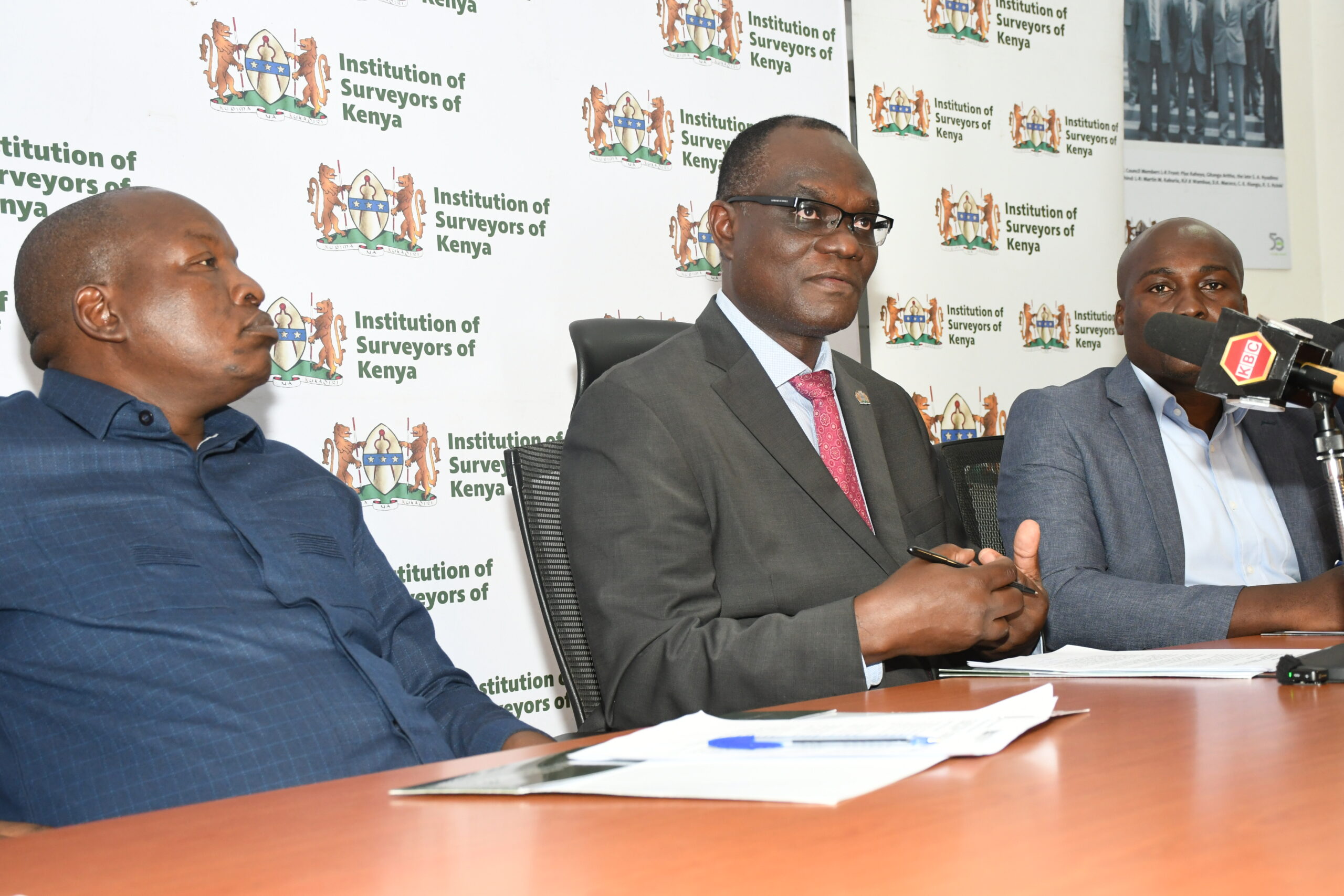
The Institution of Surveyors of Kenya (ISK), led by President Eric Nyadimo have sought parliament to pass laws regarding the embattled riparian lands following the demolitions within the city of Nairobi
The proposal comes hours after the Nairobi Rivers Commission intensified its crackdown on illegal developments, issuing over 300 enforcement notices for building and structures built on riparian land along the Nairobi River and its major tributaries
While addressing journalists at Institutions office, the President said that some of the developments were built in safer areas only to be encroached later by the change of weather and endangering climate change
The institute, however, raised concern over what it termed inconsistent interpretation and enforcement of laws governing riparian reserves, saying the situation had created uncertainty, disputes and economic losses following recent demolitions along Nairobi rivers.
The statement comes amid ongoing enforcement operations by the Ministry of Lands, Public Works, Housing and Urban Development and remarks by Nairobi Governor Johnson Sakaja regarding structures built on riparian land.
ISK said multiple laws, differing technical definitions and lack of harmonised standards had complicated the management of riparian reserves in Kenya.
“The issue on riparian reserve is about use and access subject to development control as envisaged in Article 66 of the Constitution,” said ISK President Eric Nyadimo.
The institution argued that riparian reserves should not automatically be treated as public land, noting that some properties bordering rivers were lawfully surveyed, allocated and registered under previous legal regimes.
According to ISK, the Constitution protects private property rights and any deprivation of land must follow due process, including compensation where applicable.
“Where a landowner was issued with a valid title based on an approved survey plan and development approvals were lawfully granted, subsequent redefinition or expansion of riparian reserve limits cannot be applied retroactively to deprive the proprietor of land without due process,” the statement said.
The body maintained that where the State acquires land previously held under valid title deeds, such action amounts to compulsory acquisition and must comply with Article 40(3) of the Constitution and the Land Act, 2012.
ISK said the government should conduct professional valuation, issue statutory notices, gazette intended acquisitions and provide prompt and full compensation before demolition or repossession of affected properties.
The institution, however, distinguished such cases from illegally acquired or fraudulently allocated land, saying unlawful developments do not enjoy constitutional protection and can be removed subject to due legal procedures.
The surveyors’ body further noted that some areas, including parts of Parklands in Nairobi, were registered before independence without legally established riparian reserves, warning that enforcement in such areas could trigger complex legal disputes.
ISK also cited inconsistencies in determining riparian boundaries, including varying setback distances, different reference points and conflicting interpretations among government agencies.
The institution called for harmonisation of laws and technical standards under the Survey Act, Environmental Management and Coordination Act, Water Act, Land Act and the Physical and Land Use Planning Act.
It urged the government to establish clear definitions for high and low water marks, seasonal rivers and buffer zones, while taking into account historical survey records and physical conditions on the ground.
The body further recommended amendments to the Survey Act to provide clearer provisions on the definition, measurement and points of reference for riparian reserves.
ISK criticised what it described as uncoordinated measurement of riparian boundaries by agencies lacking technical expertise.
“The mapping and delineation of riparian reserves should be done by the Director of Surveys or a licensed surveyor as per the Survey Act,” the statement said, adding that agencies such as NEMA and the Water Resources Management Authority should refrain from independently undertaking such measurements.
The institution also called for meaningful public participation, adequate notices, protection of the right to administrative fairness and access to courts before demolition exercises are undertaken.
It said demolition should only be used as a last resort after all legal and compensatory processes have been exhausted.
On flooding, ISK attributed the increasing incidents to poor urban planning, blocked drainage systems, overdevelopment, destruction of vegetation cover and inadequate storm water management.
The body proposed a series of interventions, including strict control of developments on riparian reserves, aerial mapping of flood-prone areas, use of geospatial technologies and enforcement of drainage regulations.
It also called for routine unclogging of drainage systems, stricter penalties for dumping waste into rivers and proper planning of infrastructure projects to ensure effective storm water drainage.
Further, ISK urged county governments to ensure development plans incorporate functional drainage systems and recommended enforcement of limits on the proportion of land covered by concrete to improve water absorption.
The institution pledged to work with government agencies, county governments and communities to ensure riparian reserve demarcation is technically accurate, legally compliant and environmentally sustainable.
“Sustainable environmental management and protection of water bodies must not come at the expense of constitutional guarantees, professional integrity or public confidence in land administration,” said Nyadimo.
ISK is the umbrella professional body representing practitioners in land surveying, valuation, building surveying, land administration, engineering surveying, geospatial information management, estate agency and property management across the country.