
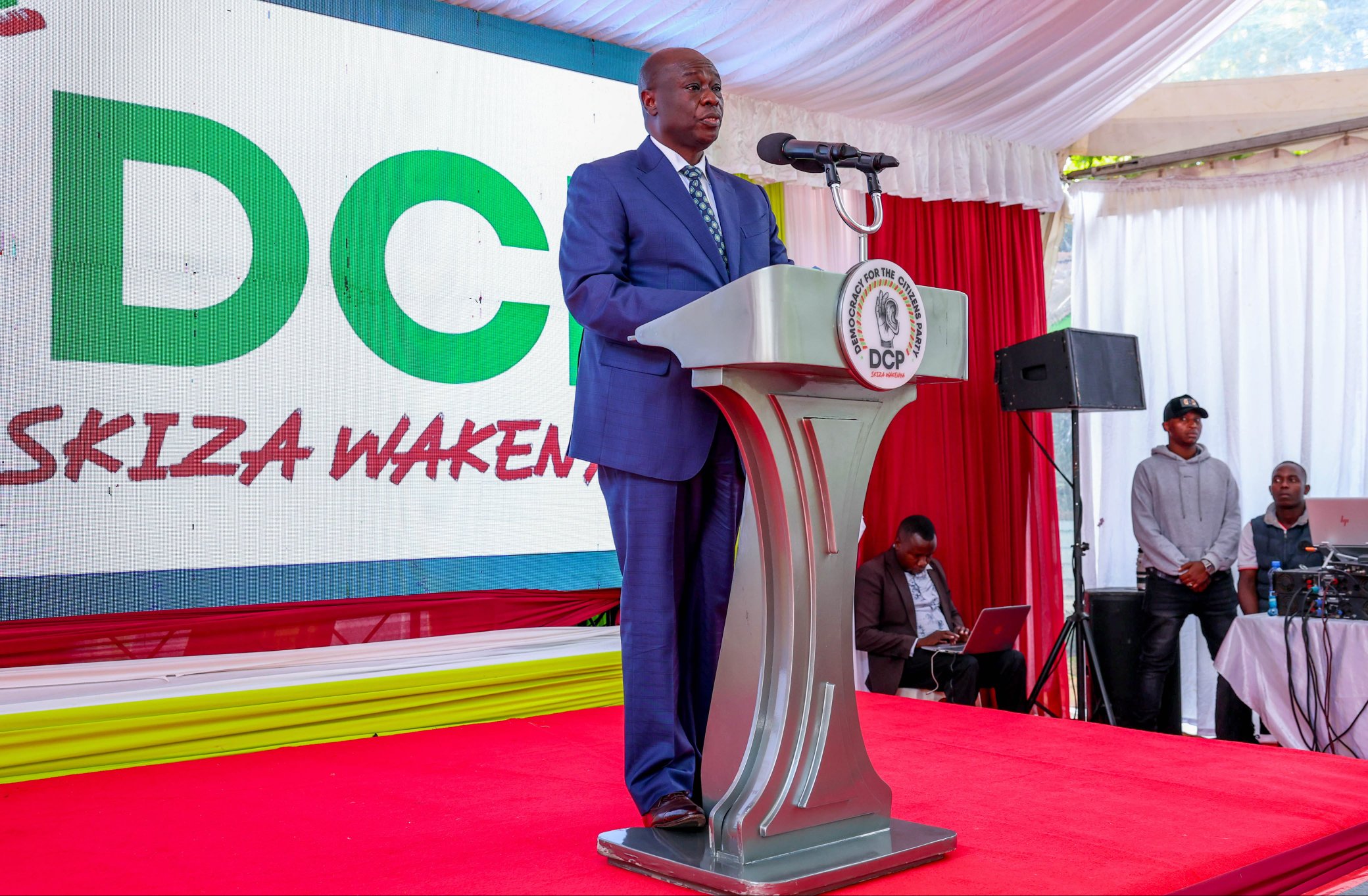

Former Deputy President Rigathi Gachagua has strongly accused President William Ruto’s government of prioritising luxury over critical sectors in the proposed 2026/27 Budget.
While addressing a press conference in Nairobi on Friday 5th June, he opposed the 2026/27 Budget Estimates and the Finance Bill 2026, terming the two documents ‘a twin evil,’ claiming they would increase the tax burden to ordinary citizens while failing to stimulate economic growth
“Despite suffocating critical sectors, the Ruto led administration continues to increase allocations to non-essential expenditures. The Presidency and State House have continued to expand up to Ksh.17 billion in this year’s budget,” Gachagua revealed.
“This is funding opulence and corruption. What does State House need Ksh.17 billion for? Are there schools and hospitals in State House?
The Democratic for the Citizens Party leader argued that education, health and agriculture should remain the government’s top priorities, saying the sectors directly affect the lives of all Kenyans.
“Kenya’s priority sectors are education, health and agriculture. These sectors touch every Kenyan and every facet of our lives. Previous informed governments gave priority and adequate funding to these sectors,” he stated.
He additionally, criticised the government’s borrowing spree, accusing the administration of violating constitutional and legal provisions that prohibit financing recurrent expenditure using debt.
“Why is this regime in an open violation of Article 211 of the Constitution of Kenya 2010 and Section 15(2)(C) of the PFM Act 2012 that strictly prohibits the financing of recurrent expenditure using debt
Gachagua, pointed out that the current administration borrows an average of Ksh.1.4 trillion annually without corresponding development outcomes.
He also launched a scathing attack on the Finance Bill 2026, describing it as ‘the worst Finance Bill in Kenya’s history.’
“The bill is deeply detrimental. It increases heavy taxation, doubles compliance pressure and escalates household costs,” he alleged.
Gachagua particularly opposed the proposal to increase excise duty on mobile phones from 10 per cent to 25 per cent, warning that it would hurt students, entrepreneurs and low-income households.
“Phones are essential tools for education, communication, financial services, content creation and job searching. Increasing the cost will widen the digital divide,” he noted.
The DCP leader accused the government of pursuing unrealistic revenue targets despite persistent underperformance in revenue collection and weak economic growth.
“At a time when Kenyans are grappling with high cost of living, rising statutory deductions, expensive credit, unemployment and weak economic growth, the Finance Bill places additional pressure on households and businesses,” he added.